How to Validate a SaaS Idea Before Writing a Single Line of Cod
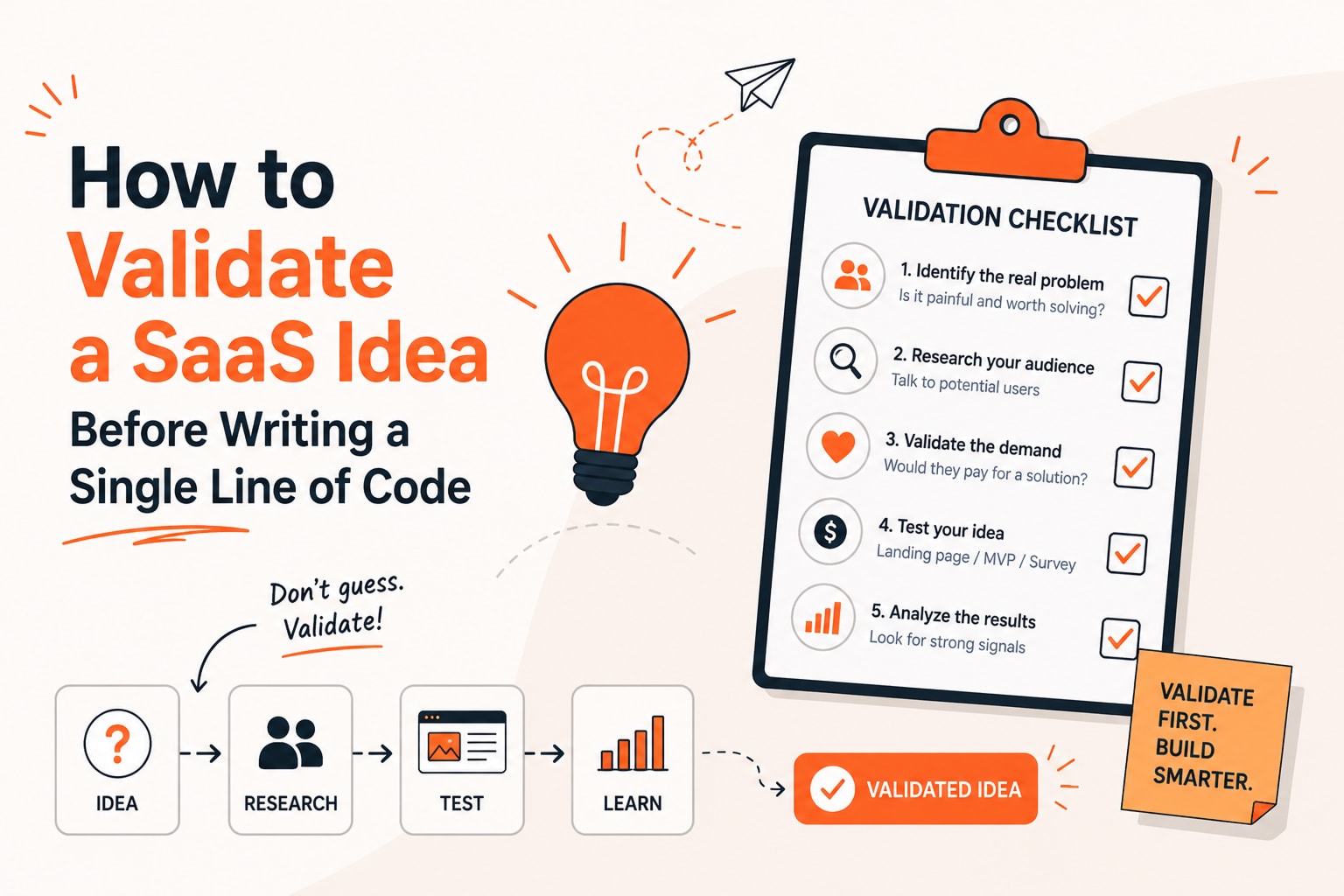
The graveyard of failed startups is filled with perfect code for products that nobody wanted. It is a common trap for developers and builders. You get an idea while drinking coffee or scrolling through a forum, and you immediately open your editor to start mapping out the database. You spend your nights and weekends building features, designing a clean interface, and setting up complex cloud infrastructure. Then the big day comes. You launch on social media, you wait for the signups to roll in, and you hear nothing but silence. This is the founder's trap, and it is entirely avoidable.
Validation is the process of proving that a market exists for your solution before you invest your most valuable resource, which is your time. Coding is the most expensive way to learn that your idea is wrong. By the time you have a working prototype, you have already spent hundreds of hours. If you find out then that the problem you solved is not actually a priority for anyone, that time is gone. Validating a SaaS idea is about shifting that learning process to the very beginning of your journey.
Why we skip validation
Most of us skip validation because it is uncomfortable. It requires us to step away from the safety of our screens and talk to real people. Coding is predictable. If you write a function correctly, it works. Humans are not predictable. They might tell you your idea is bad, or worse, they might tell you it is good just to be nice, and then never open their wallets when you ask for a payment.
We also skip it because we are in love with our own solutions. We see the vision clearly in our heads, and we assume everyone else will see it too. But a successful business is not built on a vision alone. It is built on solving a specific pain point for a specific group of people who are willing to pay to make that pain go away. Validation is the reality check that ensures your vision aligns with market needs.
Identifying the burning problem
Every great SaaS starts with a problem, not a feature. If you start with a feature, you are a solution looking for a problem. This is a difficult way to build a company. Instead, you should look for a burning problem. A burning problem is something that keeps your target customer awake at night. It is a task that takes them ten hours when it should take ten minutes. It is a source of constant frustration or a direct loss of money.
To find these problems, you need to observe how people work. Look at the spreadsheets people use to manage complex tasks. Spreadsheets are often the precursors to successful SaaS products. If someone is using a messy, manual spreadsheet to track their inventory or manage their client outreach, they are likely desperate for a better way to do it.
Do not just look for problems you have yourself. While building for yourself is a great starting point, it can lead to a very narrow market. Look for patterns across different industries. Are there common complaints on niche forums? Are people asking for specific features in the comment sections of your competitors? These are all signals of unmet needs.
The landing page test
Once you have a hypothesis about a problem and a potential solution, the next step is to create a landing page. This is sometimes called a smoke test. The goal of this page is not to sell a finished product, but to sell the value proposition of the product you plan to build.
Your landing page needs three main components. First, a clear headline that explains exactly what the product does and who it is for. Avoid vague marketing jargon. Instead of saying we empower teams to achieve synergy, say we help freelance designers automate their invoicing in five minutes.
Second, you need a few bullet points that highlight the main benefits. Focus on the outcome for the user, not the technical specifications. They do not care about your tech stack; they care about saving time or making more money.
Third, and most importantly, you need a call to action. This is usually an email signup box. You can frame it as joining a waitlist or getting early access. If someone is willing to give you their email address based on a simple description of a product, you have found a spark of interest. If you drive a few hundred people to the page and nobody signs up, you need to rethink your messaging or the idea itself.
The art of customer interviews
If the landing page shows interest, you need to start talking to the people who signed up. This is where most founders get nervous, but it is the most insightful part of the process. The goal of these interviews is not to pitch your product. In fact, you should barely mention your product at all.
You want to learn about their current workflow. Ask them how they are currently solving the problem you identified. How much time does it take? How much does it cost? What is the most frustrating part of the process? The most important questions are about past behavior. Do not ask if they would use a tool like yours in the future. Everyone says yes to that because it costs them nothing to be polite. Instead, ask when was the last time they tried to find a solution to this problem. If they have never looked for a solution, the pain might not be as bad as you think.
Listen more than you talk. If they start complaining about something else entirely, follow that thread. You might discover a much bigger problem that you are better equipped to solve. These conversations give you the language your customers use, which you can then use to improve your landing page and your marketing.
Pre selling and letters of intent
The ultimate form of validation is a financial commitment. It is one thing for someone to give you an email address; it is another thing entirely for them to give you their credit card details for a product that does not exist yet.
If you are building a tool for individuals or small businesses, try pre selling a lifetime deal or a discounted yearly subscription. Tell them the product is under development and that they are getting a special price for being an early supporter. If you can get ten people to pay you before you have built anything, you have a very high level of validation.
If you are building for larger companies, you might use a letter of intent. This is a non binding document where a potential customer states that they intend to purchase the software if it meets certain requirements. While it is not a guaranteed sale, it is a serious signal of intent that can give you the confidence to start building.
Analyzing market gaps and competitors
Many founders are discouraged when they see competitors. They think that if a solution already exists, there is no room for them. In reality, competition is a great form of validation. It proves that people are already paying for a solution to this problem.
Your goal is to find the gap in the existing solutions. Read the negative reviews of your competitors. What are people frustrated with? Is the current software too complex? Is it too expensive? Does it lack a specific integration that is essential for a certain niche?
You do not need to build a better version of everything. You just need to be better at one specific thing for a specific group of people. This is the strategy of niching down. Instead of building a generic project management tool, build a project management tool specifically for landscape architects. By focusing on a narrow niche, you can solve their specific problems much better than a general tool ever could.
Using social media for early signal
Platforms like Twitter/X, LinkedIn, and Reddit are gold mines for idea validation. You can start by sharing your thoughts on a particular problem and seeing how people respond. If a post gets a lot of engagement, it is a sign that you have touched on a common pain point.
You can also join relevant groups and participate in discussions. Do not go in and spam your landing page link. Instead, provide value. Answer questions, share your own experiences, and listen to what others are saying. When you see someone complaining about the very thing you want to solve, send them a direct message. Ask them if they would be open to a ten minute call to discuss their challenges. Most people are happy to talk about their problems if they think someone is listening.
This approach builds your authority and your audience at the same time. By the time you are ready to launch, you will have a group of people who already know you and trust your expertise.
The role of a roadmap in validation
A roadmap is not just a plan for what you will build; it is a tool for ongoing validation. Once you have a few early supporters, show them your roadmap. Ask them to rank the features in order of importance. This ensures that you are always working on the things that provide the most value.
A public roadmap also creates transparency. It shows your potential customers that you are actively thinking about the future of the product. It gives them a reason to sign up now, even if a certain feature they need is not yet available. They can see exactly when it is scheduled to be built.
This process of collaborative planning keeps you aligned with your market. It prevents you from drifting away into building features that only you think are cool. Your users become your advisors, and their feedback becomes the blueprint for your product.
Avoiding the false positive
One danger in validation is the false positive. This happens when you get a lot of interest but no actual sales. This often happens if your price is too low or if you are solving a problem that is a nice to have rather than a necessity.
To avoid this, be honest about the cost. If you are doing interviews, tell them the expected price of the software. If they hesitate, ask why. Is it too expensive compared to the value it provides? Or do they simply not have the budget for this kind of tool?
Also, watch out for the professional feedback givers. These are people who love to talk about startups and give advice but never actually buy anything. Focus your attention on the people who are currently spending money or time to solve the problem, even if their current solution is inefficient.
Building the smallest possible version
Once you have enough validation to feel confident, you still should not build the full product. Instead, build a minimum viable product. This is the smallest version of your idea that still provides value to the user.
If your idea is a complex automation tool, your first version might just be a simple script that you run manually for your customers. This is often called a concierge mvp. You do the work behind the scenes, and the customer gets the result. This allows you to learn exactly what steps are involved and what challenges arise before you spend time writing code to automate it.
The goal is to get something into the hands of users as quickly as possible. Real usage data is the best form of validation. You will quickly see which features people actually use and which ones they ignore. This data is much more reliable than anything someone tells you in an interview.
How IndieRoadmaps helps you validate
Validation does not stop once you start building. It is a continuous process that should last throughout the life of your SaaS. This is why a tool like IndieRoadmaps is so valuable for indie hackers.
When you create a roadmap on IndieRoadmaps, you are essentially creating a live validation board. You can list the features you are considering and let your audience vote on them. This gives you a clear, data driven signal of what your users want next. It takes the guesswork out of your development cycle.
By sharing your roadmap publicly, you also build a community of people who are invested in your journey. They see your progress, they see how you respond to feedback, and they feel like they are part of the process. This level of engagement is a powerful form of validation itself. It shows that there are real people who care about what you are building.
IndieRoadmaps also helps with accountability. When you put a feature on a public roadmap, you are making a commitment. This pressure helps you stay focused on shipping and prevents you from getting distracted by new, unvalidated ideas. It keeps you on the path to building a product that people actually want and are willing to pay for.
Summary of the validation process
Validation is about reducing risk. You start by identifying a deep pain point and making a hypothesis about how to solve it. You test that hypothesis with a landing page to see if people are interested. You then conduct interviews to understand the problem from the perspective of your customers.
If the signal is strong, you try to get a financial commitment through pre sales or letters of intent. You analyze your competitors to find a unique angle and you use social media to build a following. Throughout this entire process, you use a roadmap to communicate your plans and gather feedback.
By following these steps, you ensure that when you finally do sit down to write that first line of code, you are building something with a high chance of success. You are no longer guessing. You are building based on evidence, and that is the mark of a professional SaaS founder.
Final thoughts
The transition from a developer to a founder requires a change in mindset. You have to value market feedback as much as you value clean code. It is tempting to hide in your editor, but the real growth happens when you engage with the world.
Do not be afraid to find out that your idea is bad. Finding out early is a victory. it frees you up to find a better idea that will actually succeed. Every failed validation is a step closer to a successful product. Use the tools at your disposal, stay close to your users, and keep your roadmap public. This is how you build a sustainable SaaS business in the modern world.