From Idea to Launch: How Indie Hackers Use Roadmaps to Stay Accountable
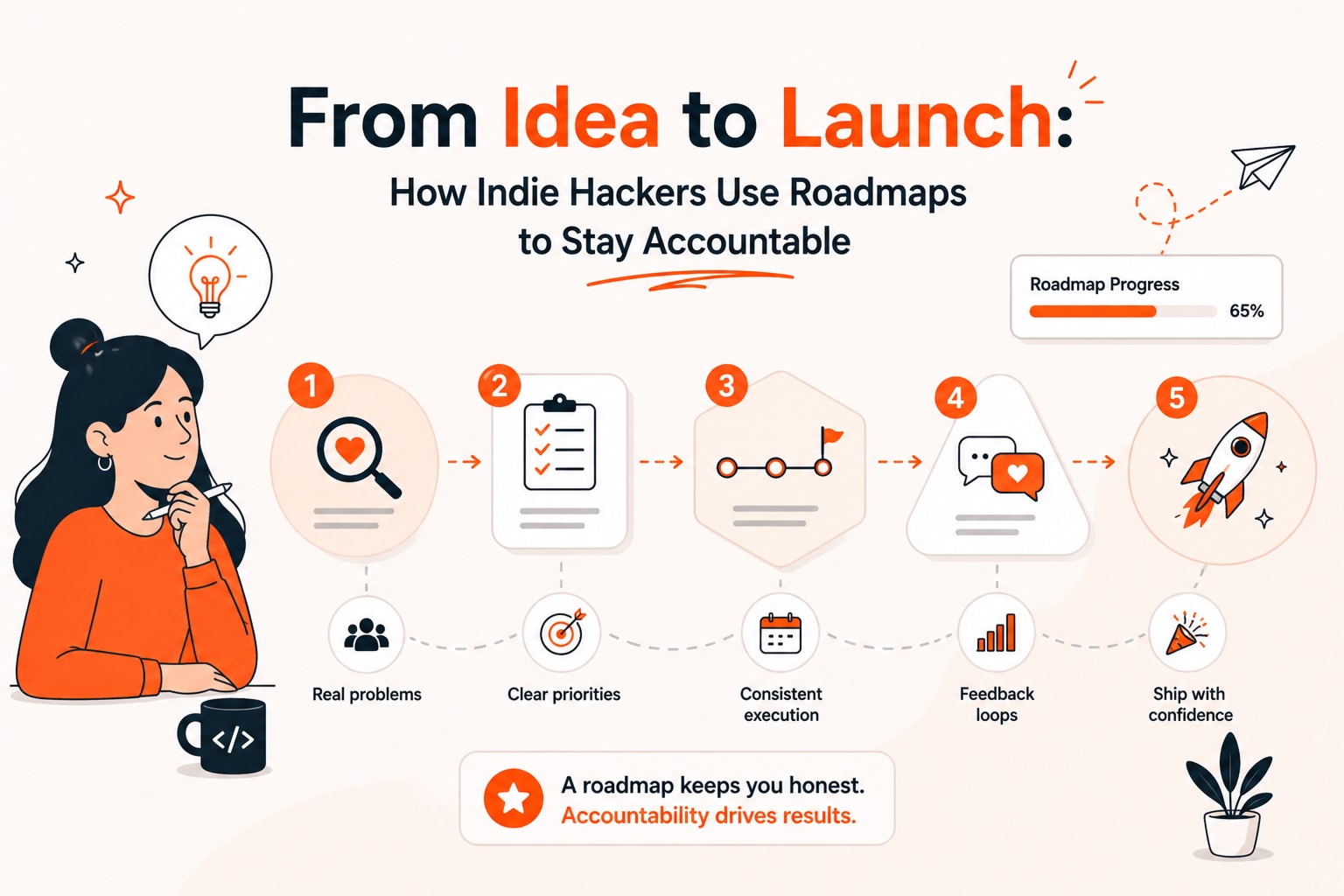
The journey of an indie hacker often begins with a burst of inspiration. You find a problem that needs solving, and your mind immediately starts racing with potential features. You might spend a few days or weeks in a state of high productivity, fueled by the excitement of a new startup idea. However, as the initial novelty wears off and the difficult work of debugging and refining begins, many founders struggle to maintain their momentum. This is the point where most projects are abandoned.
Without a structured plan, the path from a basic idea to a successful product launch is filled with distractions. There is always a new technology to learn, a different marketing strategy to try, or a secondary feature that seems more interesting than the core functionality. A product roadmap acts as a visual and psychological anchor. It provides the clarity needed to navigate the long middle period of development where motivation typically dips.
The problem of the solo founder
Accountability is easy to find in a corporate environment. You have managers, stakeholders, and colleagues who expect you to deliver on your promises. If you miss a deadline, there are consequences. For an indie hacker, there is no such structure. You are the CEO, the developer, and the marketing team. If you decide to take a week off or shift your focus to a completely different project, nobody is there to stop you.
This total freedom is one of the biggest draws of indie hacking, but it is also a significant risk. Many founders fall into the trap of constant tinkering. They refine the same small feature for months because they are afraid to launch and face the possibility of failure. Others jump from one idea to the next, leaving a trail of half finished products behind them. A roadmap changes the nature of your commitment. It moves your goals from your head onto a page where they can be tracked and measured.
Defining the roadmap structure
A roadmap for a solo founder should not be as complex as one used by a massive corporation. It does not need complicated timelines or resource allocation charts. Instead, it should focus on the sequence of value. You need to identify the absolute minimum set of features required to solve the problem for your users.
The most effective structure for an indie hacker roadmap often involves three main categories: now, next, and later. This simple system keeps you focused on your immediate tasks while allowing you to keep track of your long term vision without getting overwhelmed.
The now category
This section contains the tasks you are working on this week. These should be small, actionable items that lead directly to a functional version of your product. By keeping this list short, you reduce the mental load of starting your work each day. You do not have to wonder what to do next because the roadmap has already decided for you.
The next category
These are the features or improvements that will follow immediately after your current work is finished. This section helps prevent the feeling of aimlessness that often occurs after a major milestone is reached. When you finish a big piece of code, you can look at the next column and immediately see the direction you need to take.
The later category
This is the home for all your big ideas and future plans. It is a vital part of staying accountable because it gives you a place to store distractions. When you have a brilliant new idea that is not essential for the launch, you do not have to ignore it. You simply put it in the later column. This allows you to stay focused on the present while knowing that your future ideas are safe.
Using milestones to create momentum
One of the biggest psychological hurdles for an indie hacker is the feeling that progress is too slow. Software development is an incremental process, and it can take a long time before a project feels like a real product. Roadmaps help solve this by breaking the journey into milestones.
A milestone is a significant event in the development process, such as completing the user authentication system or finishing the first draft of the landing page. Reaching a milestone provides a natural point for celebration and reflection. It gives you a tangible sense of achievement that keeps your motivation high.
When you map out these milestones in advance, you create a series of finish lines. Instead of looking at the massive task of launching a whole company, you only have to look at the next milestone. This makes the work feel more manageable and less intimidating. Each milestone you pass builds confidence and reinforces your identity as someone who finishes what they start.
Public accountability as a superpower
While a private roadmap is helpful, a public roadmap is a game changer for accountability. Many successful indie hackers choose to share their progress openly with their audience. This is the core of the build in public movement. When you tell the world that you are going to launch a specific feature by a certain date, you create a social contract.
The knowledge that people are watching your progress provides a powerful incentive to keep moving. It is much harder to abandon a project when you have a community of followers who are excited to see it succeed. Public roadmaps turn your development process into a shared journey. Your followers become stakeholders who offer encouragement, feedback, and sometimes even a gentle push when they notice things have stalled.
This transparency also helps with marketing. A public roadmap shows potential users that you are active and committed. It builds trust before the product is even launched. People are more likely to support an indie hacker who is honest about their goals and their progress.
Managing the pre launch phase
The final weeks before a product launch are often the most stressful. This is when the lists of bugs and small tasks seem to grow exponentially. Without a roadmap, it is easy to get stuck in a loop of endless polishing. You might feel that the product is never quite ready for the public.
A roadmap helps you define the point of enough. It allows you to look at your list of features and decide which ones are truly essential for version one. By setting a clear definition of what constitutes a launchable product, you give yourself permission to stop building and start shipping.
During this phase, your roadmap should focus on stability and user experience. You might move complex new features to the later column to ensure that the core product is solid. Having this written down helps you resist the urge to add just one more thing before you hit the launch button.
Accountability beyond the launch
The need for a roadmap does not disappear once the product is live. In fact, it becomes even more important. After a launch, you will likely be flooded with feedback, bug reports, and feature requests. It is easy to feel overwhelmed by the volume of information.
A post launch roadmap helps you filter this feedback. It allows you to organize user requests and see which ones align with your overall vision for the product. It also shows your early users that you are listening and that the product will continue to improve. This is essential for reducing churn and building a loyal customer base.
By keeping your roadmap updated after the launch, you maintain the same sense of accountability that got you to the starting line. It ensures that you continue to grow the business rather than just maintaining the status quo. It keeps you focused on the long term goals that will turn a small project into a sustainable company.
The role of documentation in staying on track
A roadmap is also a form of documentation. It records the evolution of your startup ideas and the decisions you made along the way. For a solo founder, this historical context is incredibly valuable. When you look back at your roadmap from six months ago, you can see how much your understanding of the problem has changed.
This reflection helps you become a better founder. You can identify patterns in your work, such as which types of tasks take longer than expected or which features generated the most user interest. This data allows you to make more accurate predictions and better decisions for your next project.
Documentation also makes it easier to bring on help if you decide to grow the team. A clear roadmap provides an immediate overview of the project status and future goals for a new freelancer or partner. It ensures that everyone is moving in the same direction from day one.
Overcoming the fear of failure through planning
Many indie hackers struggle with accountability because they are fundamentally afraid that their product will fail. If you never finish the project, you never have to face the possibility that nobody wants it. This subconscious fear can lead to procrastination and self sabotage.
A roadmap helps confront this fear by making the process objective. It shifts the focus from the outcome to the progress. When your goal is to complete the tasks on your roadmap, you can feel successful every day, regardless of how many signups you have. This focus on the craft of building helps reduce the anxiety associated with launching a new business.
By treating each task as an experiment, you can approach your startup ideas with a sense of curiosity rather than dread. If a feature does not work as expected, you simply update the roadmap and try the next thing. This iterative approach is the hallmark of a resilient indie hacker.
How IndieRoadmaps supports your journey
Staying accountable is much easier when you have the right tools. IndieRoadmaps was designed specifically to help solo founders and small teams navigate the transition from idea to launch. It provides a simple, intuitive platform for building and sharing your product roadmap.
With IndieRoadmaps, you can quickly organize your features into the planning, building, and shipped framework. This keeps your daily work focused and your future goals clear. The platform is built for speed, so you can spend less time managing your tasks and more time building your product.
The voting system is particularly powerful for indie hackers. It provides a direct line of communication between you and your audience. When you see which features are most popular, you can adjust your roadmap to prioritize the work that will have the biggest impact. This ensures that you are always building what people actually want.
IndieRoadmaps also helps you celebrate your progress. The platform makes it easy to move items to the shipped column, providing a visual record of your achievements. This historical view is a great source of motivation during the inevitable slow periods of startup life. It reminds you of how much you have already accomplished and gives you the energy to keep pushing forward.
Whether you are just starting to explore a new startup idea or you are preparing for a major product launch, IndieRoadmaps provides the structure and support you need to stay accountable. It turns your vision into a practical plan and helps you build a community around your work.
The final push to the finish line
Launching a product is one of the most rewarding experiences a developer can have. It is the culmination of weeks or months of hard work, creativity, and persistence. A product roadmap is the thread that connects all that effort and keeps you moving toward the finish line.
By using a roadmap to stay accountable, you increase your chances of success significantly. You avoid the traps of distraction and procrastination. You build trust with your audience and you create a product that is driven by real user needs. You move from being someone with a good idea to being someone who ships great software.
Remember that the goal of a roadmap is not to create a perfect plan that never changes. It is to provide a sense of direction and a framework for making decisions. Be flexible, listen to your users, and stay committed to the process. Your roadmap is the map, but you are the one doing the driving.
Summary of the indie hacker roadmap process
Break your startup ideas into small, manageable milestones.
Consider making your roadmap public to leverage the power of social accountability.
Use your roadmap to define a clear point of enough for your initial product launch.
Continue to use and update your roadmap after the launch to manage feedback and growth.
Use tools like IndieRoadmaps to simplify the process and engage with your community.
The discipline of maintaining a roadmap is what separates successful indie hackers from those who are perpetually stuck in the idea phase. It is the foundation of a professional approach to building a business.
Start your roadmap today and take control of your journey from idea to launch. With a clear plan and a commitment to accountability, there is no limit to what you can build.