How to Know If Your Idea Is Worth Building: 5 Validation Questions
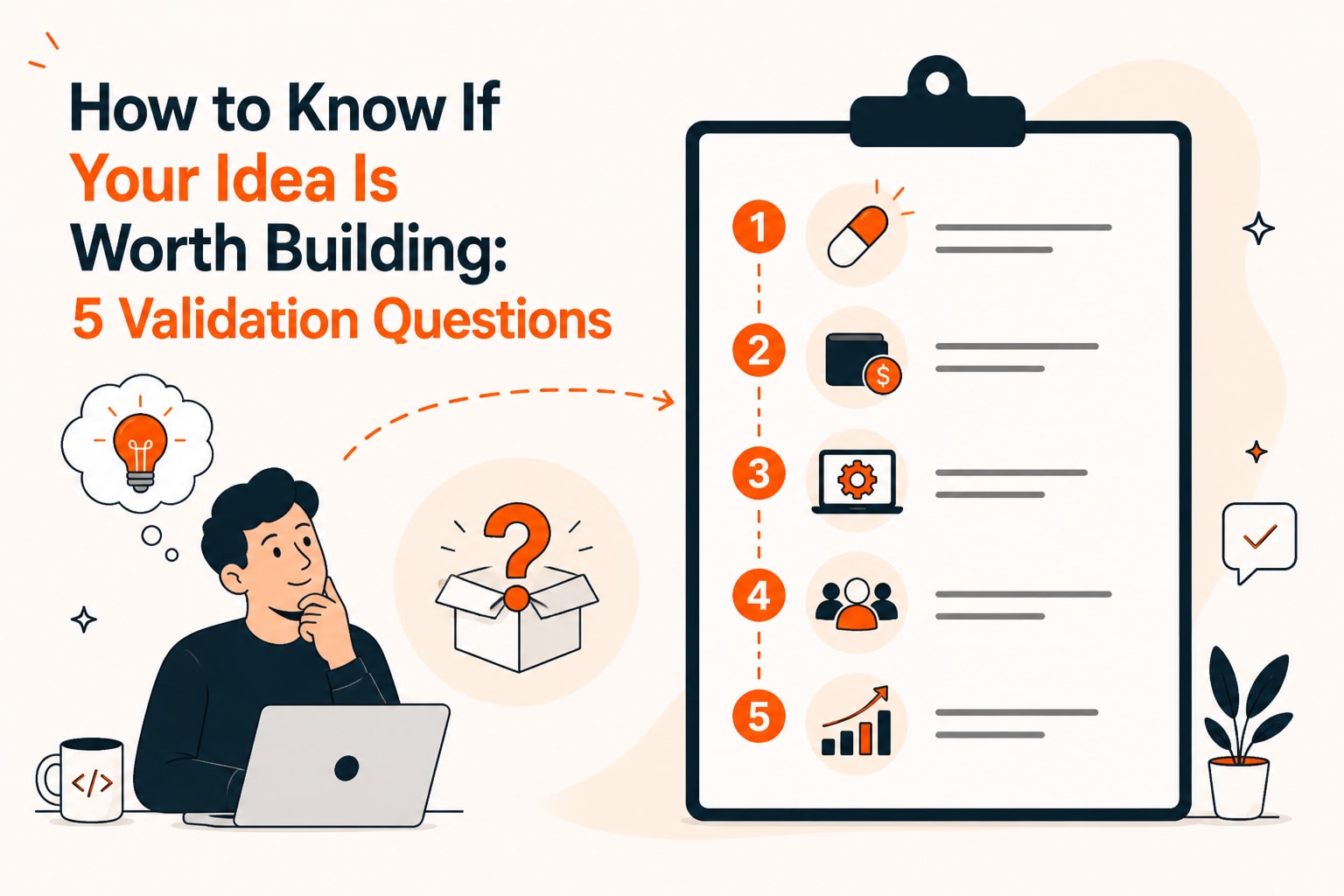
Every indie hacker has a notebook or a notes app filled with potential startup ideas. Some of these ideas feel like they could be the next big thing. Others are just small tools to solve a personal annoyance. The problem is that our brains are very good at lying to us. We fall in love with our own solutions before we truly understand the problems. We imagine a world where thousands of people sign up for our product on day one. This excitement is what gets us started, but it is also what leads us into the trap of building something that nobody wants.
Validation is the process of stripping away the emotion and looking at the facts. It is the most important part of the startup journey. If you spend three months building a product that fails because of a bad technical choice, you can fix the code. If you spend three months building a product that fails because there is no market, you have wasted your time. The goal of these five questions is to help you kill your bad ideas early so you can focus all your energy on the ones that have a real chance of success.
Question 1: Is this a vitamin or a painkiller?

This is the classic test for any software product. A vitamin is something that makes a situation slightly better. It is a nice to have tool. For example, a social media app that helps you organize your favorite cat videos is a vitamin. It is enjoyable, but nobody is going to have a crisis if it does not exist. A painkiller, on the other hand, solves a specific and urgent problem. If a business owner is losing five hours a week to manual data entry, a tool that automates that process is a painkiller.
Painkillers are much easier to sell than vitamins. When someone is in pain, they are actively looking for a solution. They are willing to pay a premium to make the problem go away. Vitamins require you to spend a lot of energy on marketing and convincing people that they need your product. As an indie hacker with a limited budget, you do not have the resources to educate a market on why they should want your vitamin. You need to find people who are already crying out for a solution.
To answer this question, look at the consequence of the problem. If the problem is not solved, does the user lose money? Does it cost them significant time? Does it cause them a lot of stress? If the answer is no, you are likely building a vitamin. While vitamins can become successful businesses, they are much riskier for solo founders. Aim for the pain.
Question 2: Is there a clear budget for this problem?

Interest is not the same as a market. You might find a lot of people who think your idea is cool. They might even join your waitlist. However, interest does not pay the bills. You need to know if the people who have the problem also have the money and the willingness to spend it on a solution.
If you are building a tool for college students, you might find a lot of pain, but students are notoriously broke. They are more likely to spend three hours finding a free workaround than to spend ten dollars on a software subscription. On the other hand, if you are building a tool for sales managers at mid sized companies, you are dealing with people who have a budget specifically for software that increases efficiency.
You should also look at how much the problem currently costs the user. If a company is paying a freelancer five hundred dollars a month to do a task, and your software can do it for fifty dollars, you have a very clear value proposition. The budget already exists. You are just offering a more efficient way to spend it. If you have to ask a user to find new money in their budget that they were not already spending, the sale will be much harder.
Question 3: How are they solving the problem right now?

A problem that is not being solved at all is a red flag. It usually means the problem is not actually that painful. Most great SaaS ideas are just better ways to do things that people are already doing. If you want to know if an idea is worth building, look for the workarounds.
Are they using a messy spreadsheet to track their inventory? Are they sending a dozen emails back and forth to schedule a single meeting? Are they hiring cheap labor to copy and paste data from one website to another? These manual and inefficient workarounds are the best indicators of a real market.
If a user tells you they have a problem, but they have never searched for a solution or tried to build their own workaround, they probably will not pay for your software. They have lived with the pain for this long, and they will likely continue to live with it. You want to find the people who are currently using a broken or annoying solution because they have no other choice. Your software should feel like a relief compared to their current process.
Question 4: Can I actually reach the target audience?

A perfect product is useless if you cannot get it in front of the people who need it. Distribution is often the downfall of solo founders. We focus so much on the features that we forget to think about the marketing channels. Before you write a line of code, you need to know exactly where your customers hang out online.
If you are building a tool for dentists, do you know how to reach dentists? They are not hanging out on Twitter or Indie Hackers. They might be in private Facebook groups, or they might read specific trade journals. If the only way to reach them is through cold calling or expensive physical mail, you might find that the cost of acquiring a customer is higher than the lifetime value of that customer.
As an indie hacker, you should look for audiences that are easy to target. Can you reach them through search engine optimization for a specific keyword? Are they active on a specific subreddit? Is there a popular marketplace or app store where they already look for tools? If you do not have a clear and affordable way to reach your audience, your idea is going to struggle to grow, no matter how good the software is.
Question 5: Is the market for this problem growing?

Timing is a critical part of startup idea validation. You want to be building in a market that is expanding. When a market is growing, there is a constant influx of new users who have not yet chosen a solution. This creates a rising tide that can carry a small startup to success.
If you are building a tool for a dying industry, you will find yourself fighting for a shrinking number of customers. The competition will be fierce, and the users will be looking to cut costs rather than invest in new tools. However, if you are building for a new trend or a rapidly growing industry, you will find that people are much more open to trying new things.
Think about the long term trends. Is the problem you are solving going to be more common in five years or less common? You want to solve problems that are becoming more frequent as the world changes. This could be due to changes in technology, changes in regulations, or shifts in how people work. Positioning yourself in a growing market is like running with the wind at your back. It makes everything easier.
The role of a roadmap in validation
Once you have asked these five questions, you might still have some uncertainty. This is normal. You can never be one hundred percent sure until you launch. However, you can use a roadmap to bridge the gap between an idea and a full product. A public roadmap is a powerful validation tool that many founders overlook.
Instead of disappearing for six months to build every feature you have imagined, you can publish a roadmap that shows your intended path. This allows you to gather feedback on specific features before you build them. If you list three potential integrations and everyone votes for the same one, you know exactly where to focus your time. This is validation in real time.
A roadmap also helps you manage expectations. It shows your early users that you have a plan and that you are listening to their needs. It turns the development process into a conversation. If you see that nobody is interested in the features you have planned for the future, you can pivot your roadmap without having wasted any time on code. It is a flexible framework for testing your assumptions in the real world.
Using IndieRoadmaps to test your assumptions
This is exactly why IndieRoadmaps is such an important resource for solo founders. It provides a dedicated place to take your validated idea and put it to the ultimate test. By creating a public roadmap on the platform, you are inviting the community to tell you if you are on the right track.
When you post your features and milestones on IndieRoadmaps, you get immediate data. You can see which items generate the most interest through the built in voting system. This acts as a secondary layer of validation. The first layer was the five questions. The second layer is the actual feedback from potential users and fellow builders.
The platform also helps you stay disciplined. It is easy to get distracted by shiny new ideas that have not been validated. Having a public roadmap forces you to stick to the plan that you have already vetted. It provides the accountability you need to move through the difficult middle stages of development. It keeps you focused on the tasks that will lead to a successful launch.
IndieRoadmaps also helps with the distribution question. Because the site is part of a larger community, your roadmap has the potential to be discovered by people who are looking for new tools. It creates an early signal for your product and starts the process of building an audience before you have even finished the MVPvp. It is a comprehensive tool for any indie hacker who wants to build something that actually matters.
Summary of the startup idea validation framework
Validating a SaaS idea is about being honest with yourself. It is about moving past the excitement of a new project and looking at the cold reality of the market. Use these five questions as your filter.
First, make sure you are solving a painful problem rather than just providing a nice to have improvement. Second, ensure that your target audience actually has the money and the willingness to pay for a solution. Third, look for the current workarounds. If people are not already trying to solve the problem, they probably do not care enough to pay you.
Fourth, have a clear plan for how you will reach your customers. If you cannot find them, you cannot sell to them. Fifth, make sure you are building in a market that is growing rather than shrinking. Finally, use a roadmap to continue the validation process as you build.
The goal is not to prove that your idea is perfect. The goal is to find the flaws in your idea as quickly as possible. If an idea fails these questions, do not be afraid to let it go. There are always more ideas. The most successful founders are not the ones who never fail, but the ones who fail fast and keep moving until they find the one that sticks.
Final thoughts
Building a startup is a long and difficult journey. You are going to invest a significant amount of your life into this project. Before you start, make sure the foundation is solid. Take the time to talk to potential users. Ask the hard questions. Look for reasons why your idea might not work.
If your idea survives this process, you can move forward with total confidence. You will know that there is a real pain, a real budget, and a real way to reach your users. You will have a roadmap to guide you and a community to support you. This is how you turn a simple idea into a sustainable and profitable business. Start your validation process today and build something that the world is waiting for.