Product Roadmap vs Backlog: What Indie Hackers Actually Need
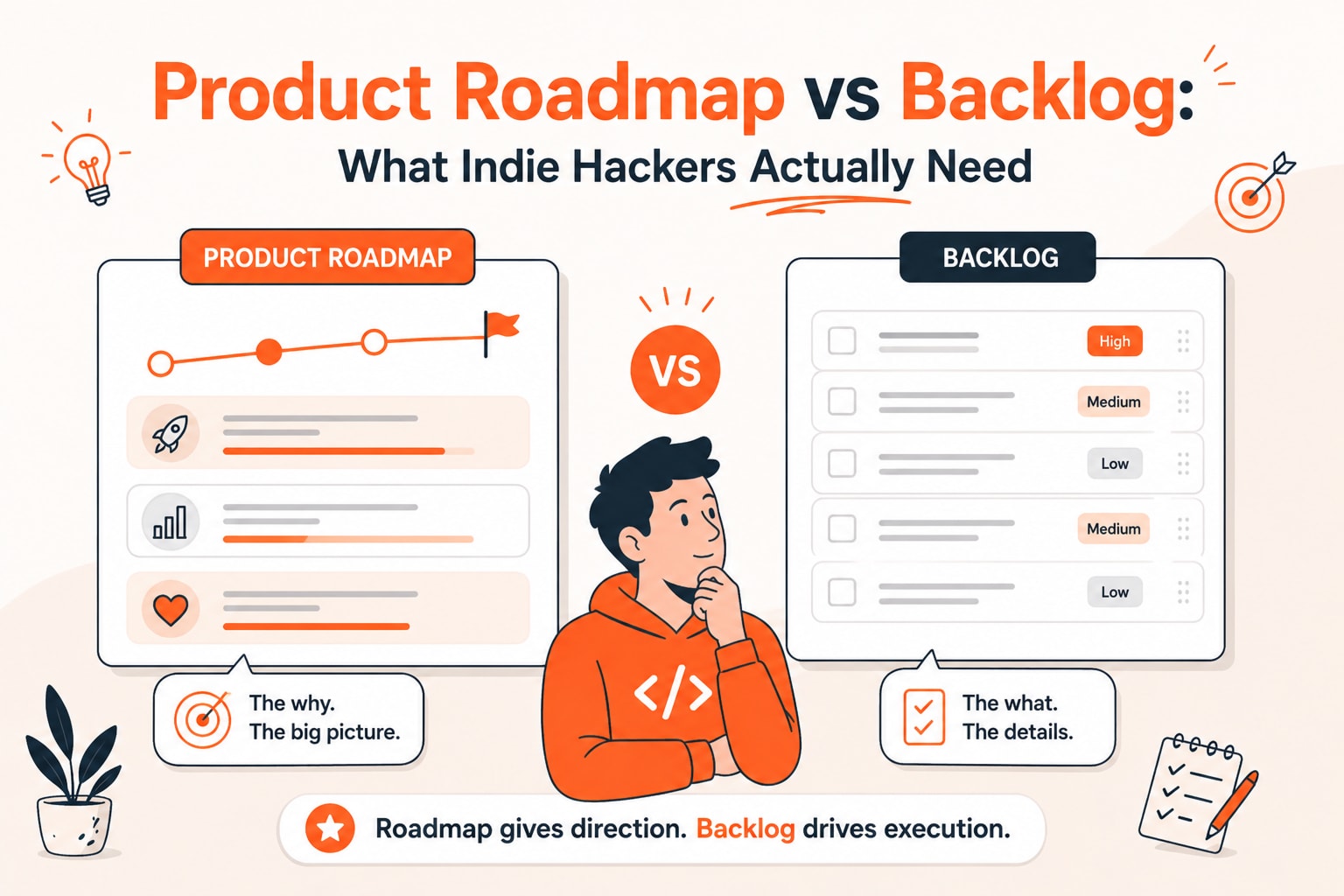
When you are building a software product on your own, it is easy to get lost in the terminology of project management. You hear people talking about backlogs and roadmaps as if they are the same thing, or as if you need a complex system to manage them. For an indie hacker, these two tools serve very different purposes. One is about the small details of the work, and the other is about the big picture of your business. Understanding the difference is the key to shipping faster without losing your mind.
The confusion usually starts when your project grows beyond a simple to do list. Suddenly, you have bug reports, feature requests from users, and a million ideas of your own. You need a way to organize them. Most founders end up with a giant list of tasks that feels impossible to finish. This is usually because they have mixed their backlog and their roadmap into one messy pile. To fix this, you need to separate your tactical work from your strategic goals.
The messy reality of the product backlog
The product backlog is where every single idea, bug report, and tiny tweak goes to live. It is the raw list of things that could be done. If a user emails you a suggestion for a button color, it goes in the backlog. If you find a small typo in your documentation, it goes in the backlog. It is essentially a storage unit for your tasks.
For a solo founder, a backlog can quickly become a source of stress. Because you are the only one working on the project, the list will always grow faster than you can check things off. This creates a sense of constant debt. You look at your list and see three hundred items, and you feel like you are failing.
The secret to a healthy backlog is to realize that you will never finish it. A backlog is not a promise. It is just a place to hold information so you do not forget it. You should feel comfortable deleting things from your backlog. If an idea has been sitting there for six months and you still have no desire to build it, it probably is not that important. Keeping your backlog lean helps you stay focused on the tasks that actually matter today.
The strategic power of the product roadmap
The product roadmap is a different beast entirely. It is a high level document that outlines where the product is headed over the next few months. It does not care about small bug fixes or button colors. It focuses on the major features and milestones that will move the needle for your business.
A roadmap is a tool for communication. It tells your users and your potential followers what you are working on and why it matters. While the backlog is for your developer brain, the roadmap is for your founder brain. It helps you step back from the code and look at the business as a whole.
A good roadmap should answer the question of what the product will look like in the future. It provides a sense of direction. For an indie hacker, this direction is essential for staying motivated. When you are deep in the weeds of fixing a difficult bug, looking at your roadmap can remind you of the bigger mission. It helps you remember that the bug fix is just a small step toward a much larger goal.
Key differences between the two
The main difference is the level of detail. A backlog item might be something like: fix the padding on the login button. A roadmap item would be something like: launch the user authentication system. The backlog is granular and technical, while the roadmap is broad and outcome oriented.
Another difference is the audience. Your backlog is usually private. It contains your messy notes, technical debt, and things that would not make sense to anyone else. Your roadmap, especially if you are building in public, is often public. It is designed to be read by humans who use your product. It needs to be clear, professional, and exciting.
The timeline also differs. A backlog is usually about the immediate future. You look at it to decide what you are going to code today or this week. A roadmap looks further out. It covers months or even quarters. It is not a schedule of exact dates, but rather a sequence of priorities.
Why solo founders need both
You might be tempted to just use a backlog and skip the roadmap. After all, if you are the only one working on it, why do you need to communicate with yourself? The problem is that without a roadmap, you will likely spend all your time on low value tasks.
It is very easy to spend a whole day fixing minor UI issues because they are easy to check off your list. At the end of the day, you feel productive, but the product has not actually improved in a meaningful way. A roadmap prevents this by forcing you to prioritize the big wins. It keeps you honest about whether you are actually building the features that your users are asking for.
On the other hand, you cannot have a roadmap without a backlog. A roadmap without a backlog is just a dream. You need the backlog to break those big roadmap items down into manageable pieces of work. The backlog is where the execution happens. It is the bridge between your vision and the actual code.
How to manage them effectively
The best way to manage these two tools is to keep them in separate places or at least in separate views. Do not let your roadmap features get buried under a pile of bug reports.
Once a week, you should look at your roadmap and decide which major goal you are focusing on. Then, go to your backlog and pull out the tasks that support that goal. This is your work for the week. Everything else in the backlog should be ignored until your main goal is achieved. This simple process ensures that your daily actions are always aligned with your long term strategy.
You should also be careful about what you put on your public roadmap. Only include things that you are reasonably sure you will build. If you put fifty features on your roadmap and only ship two of them, you will lose the trust of your audience. It is better to have a small, focused roadmap that you actually follow than a massive one that never changes.
Avoiding the trap of over planning
Indie hackers often fall into the trap of spending more time planning than building. You do not need a complex project management suite with charts and graphs. You just need a way to track your tasks and a way to share your vision.
The more time you spend tweaking your project management setup, the less time you have to write code. Keep your backlog as simple as possible. A basic list is usually enough. For your roadmap, use a format that is easy to update and share. The goal is to spend five minutes a week on planning so you can spend forty hours on building.
Remember that both your roadmap and your backlog are living documents. They should change as you learn more about your market and your users. If you realize that a feature on your roadmap is no longer a good idea, remove it. If a bug in your backlog is no longer relevant because you rewritten that part of the app, delete it.
The psychological benefit of the roadmap
Building a SaaS is a marathon, and it can be very lonely. There will be days when you feel like you are making no progress. On those days, the roadmap is your best friend. It shows you how far you have come and how much you have already achieved.
When you can mark a major roadmap item as complete, it gives you a massive boost of dopamine. It is much more satisfying than checking off a tiny bug fix. This sense of momentum is what keeps you going through the difficult parts of the journey. It turns the long, boring process of development into a series of exciting milestones.
Sharing this roadmap with others adds another layer of motivation. When people see what you are building and tell you they are excited for it, you feel a responsibility to deliver. This social accountability is one of the most powerful tools in an indie hacker toolkit.
Bridging the gap with IndieRoadmaps
If you are looking for a simple way to manage your public vision without getting bogged down in complex tools, IndieRoadmaps is built for exactly this purpose. It is designed to help you separate the signal from the noise.
IndieRoadmaps gives you a dedicated space for your product roadmap that is separate from your internal task lists. It allows you to present your goals in a way that is clean and easy for your users to understand. You can list your upcoming features, show what is currently in progress, and celebrate what you have already shipped.
One of the best features is the ability for users to interact with your roadmap. They can vote on the features they want most, which helps you decide what should move from your private backlog onto your public roadmap. This turns your roadmap into a validation tool. You are no longer guessing what to build; you are building what your community is asking for.
Using IndieRoadmaps also helps you stay consistent. Because your roadmap is public, you have that extra nudge to keep it updated and to keep making progress. It is a simple, effective way to show the world that your project is alive and growing.
A backlog and a roadmap are both essential, but they serve different masters
Your backlog serves your daily productivity, while your roadmap serves your long term success. By keeping them separate and understanding their unique roles, you can avoid the overwhelm that stops so many solo founders.
Focus on keeping your backlog lean and your roadmap ambitious. Use your roadmap to guide your strategy and your backlog to guide your execution. When you find the right balance between the two, you will find that you can ship better features faster and with much less stress.
The path of the indie hacker is about making smart choices with your limited time. Choosing to use a clear roadmap is one of the smartest choices you can make. It clarifies your vision, engages your audience, and keeps you moving forward toward your goals. Start organizing your vision today and give your product the direction it needs to succeed.