How I Built IndieRoadmaps: A Public Roadmap Builder for Indie Hackers
The idea
I wanted a place where indie makers could publicly showcase what they're building, not just a launch post on Product Hunt, not a thread on X, but a living roadmap that shows the world exactly what you're working on and where you're taking it.
The idea came from watching the build in public movement and feeling like something was missing. Indie hackers were sharing updates, but it was scattered: a tweet here, an IH post there. There was no single place where you could go and see, in a structured way, what indie hackers were actually building next. No accountability layer. No way to follow a product's journey from idea to shipped feature.
So I went looking. Checked what was out there on X, browsed Product Hunt, did my Google searches. Nothing matched what I had in mind. The tools that existed were either too corporate, built for SaaS companies managing customer feedback, or too informal, just social posts with no structure. The gap was clear.
What I wanted to build was different. A public product roadmap tool specifically made for indie hackers, where anyone can see what you're committed to building. That last word matters: committed. When your roadmap is public and other makers can see it, vote on features, and follow your progress, it creates a kind of accountability that a private Notion doc never will. You said you'd build it. People are watching. That changes how you show up.
But the vision goes further than that. I see IndieRoadmaps becoming the place where you can see what's being built today, across the entire indie hacking space. Who are the most prolific builders? What kinds of products are getting the most traction? What features are people actually voting for? Over time it becomes an aggregation tool, a research tool, a pulse on where indie software is heading. Every indie hacker referencing it when they want to know what's being built right now.
That's the gap I saw. And once I saw it, I had to build it.
What's the build story for IndieRoadmaps
I'd been wanting to get my hands on Next.js and Supabase for a while. IndieRoadmaps felt like the right project to finally do it properly, building something real rather than following a tutorial.
Supabase won me over fast. The developer experience is just genuinely good: the dashboard is clean, the docs are solid, and getting auth, a database, and row-level security up and running takes hours instead of days. I've worked with a lot of backend tools over the years and Supabase is one of those rare ones that actually feels like it was built for people who want to ship quickly without cutting corners. Vercel on the hosting side is the same story: push to main, it's live. No fuss whatsoever.
I did the architecture myself, same as with AIApplePie. Knowing how the data flows before writing a single line of code is something I've learned to value. It saves a lot of painful refactoring later. For the actual coding and debugging, Claude was in the mix again, and I'll keep saying it without shame: building solo is faster with a good AI co-pilot.
The timeline was tight. I had the initial idea at the end of February, and IndieRoadmaps was live on March 13. Two weeks from concept to launched product. That's the thing about having some experience under your belt: you know what to build, what to skip, and how to make decisions quickly without second-guessing everything. The lessons from AIApplePie were fresh, and I applied them. Ship fast, polish later.
What are the main features of IndieRoadmaps?
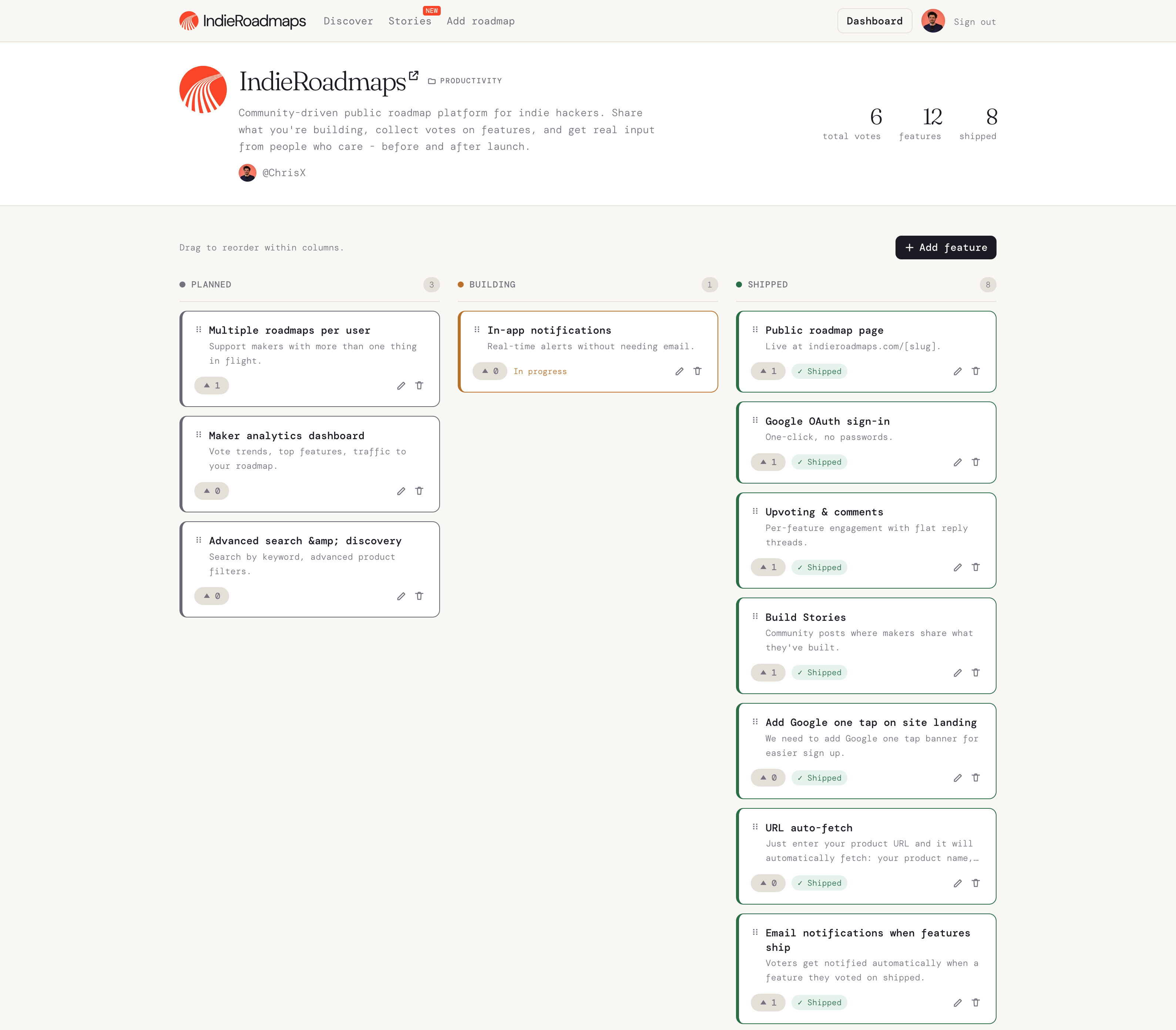
At its core, IndieRoadmaps is a public roadmap builder. You create your product, add your planned features, set their status, and publish. Your roadmap is live, shareable, and visible to anyone who wants to follow what you're building. That's the foundation everything else sits on.
On top of that, every feature on your roadmap is open to public voting. Your audience can vote on the features they want to see built next, which gives you a real signal on what actually matters to the people using your product. And when you mark a feature as shipped, everyone who voted on it gets an email notification automatically. No chasing people down, no update posts. They just get told via email (for now).
Then there are Build Stories, like this one. A place where indie hackers can share the real story behind their product: how the idea came about, how it was built, what the launch looked like, and what they learned along the way. Honest & structured.
What I like most about how Build Stories work on IndieRoadmaps is that every story is connected directly to the maker's live roadmap on the platform. You read the story, you get curious about the product, you click through and you're on the roadmap. You can see exactly what's being built next, vote on features, and follow the journey from that point forward. The story and the product live together, which is something you won't find on Indie Hackers or anywhere else.
The launch
I launched on X first, posting into the build in public community. The response was minimal, and I won't pretend otherwise. My audience is small right now, and shouting into a low-follower account is pretty much shouting into the void. That's just the reality of starting from scratch with no existing audience to activate.
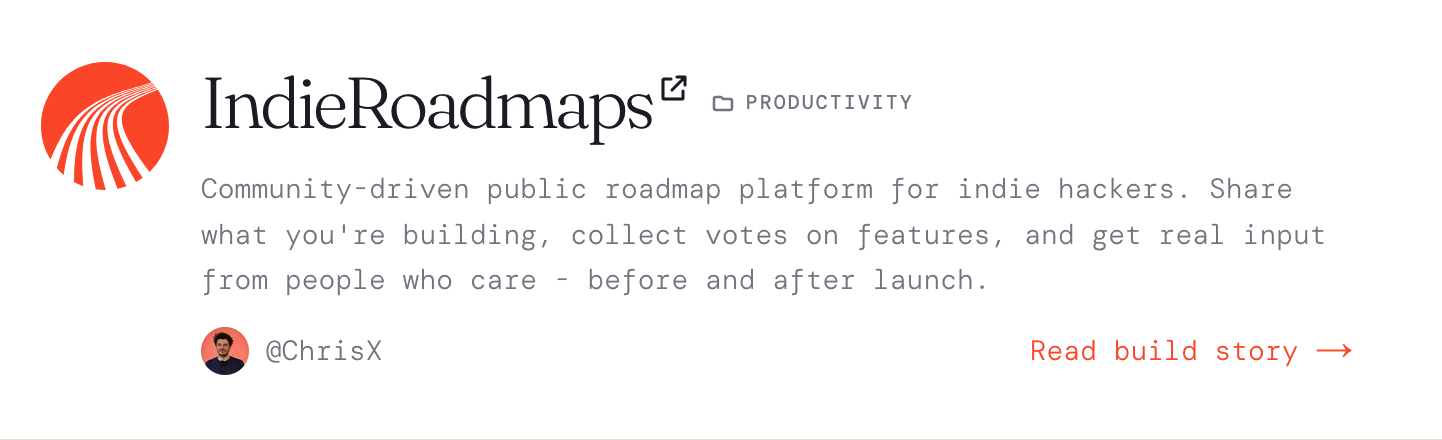
So I changed approach and went direct. Started reaching out personally to other indie hackers on X, one by one, showing them IndieRoadmaps and asking if they'd want their product roadmap on the platform. And something interesting happened: some of them were genuinely excited. Not politely interested, actually excited. That response told me the idea resonated, at least with the right people. That's how the first three or four roadmaps landed on the site, and honestly it felt better than any viral launch would have. Real makers, real products, real validation.
Right now I'm working on SEO and getting IndieRoadmaps listed on directories and platforms similar to Product Hunt. It's the unglamorous side of distribution: slow, methodical, no dopamine hits. But it compounds over time and I've learned to respect it.
Product Hunt is coming. I made a deliberate call not to launch there on the same day as the X launch. PH is a one-shot opportunity and I want to go in with some social proof already on the platform, a few roadmaps live, some early users who can vouch for it. Timing a PH launch right matters more than launching fast.
The honest summary: early days, slow start, but the signal from direct outreach was encouraging enough to keep pushing.
Lessons
AIApplePie taught me an expensive lesson about polishing. I spent days, sometimes weeks, tweaking UI elements and refining features that nobody had asked for and nobody noticed when they shipped. It's a trap that I think most first-time indie hackers fall into, because building feels productive. You're doing something. The problem is you're doing the wrong something.
With IndieRoadmaps I applied that lesson from day one. Define the core feature, build it until it works, ship it. Everything else is noise until you have real users telling you what they actually need. That's why the site went from idea to live product in two weeks. Not because I rushed it, but because I was ruthless about scope. One main feature: the roadmap builder. Get that right, get it live, then listen.
The 90/10 rule is real. That last 10% of polish takes as long as the first 90% of the build, and it delivers almost none of the value. Ship at 90% and spend that remaining time talking to your audience instead. You'll learn more from one real user conversation than from a week of solo refinement.
Building solo is still a lot to carry. Every decision is yours, every mistake is yours, and there's no one to reality-check you when you're going down a rabbit hole. But two products in, I'm getting better at trusting my own instincts and knowing when to stop building and start shipping.
The biggest difference between AIApplePie and IndieRoadmaps wasn't the tech stack or the idea. It was that I went into this one knowing what I was actually trying to prove, and I gave myself a hard deadline to prove it.
One last thing
What excites me most about IndieRoadmaps is what it can become. The feedback so far has been good, genuinely good, and that tells me the idea is solid. The work now is distribution, getting more makers on the platform, more roadmaps live, more voters engaging with what's being built. That's the phase I'm in and I'm not underestimating it this time.
IndieRoadmaps has the potential to become something every indie hacker will reference. A place where you can take the pulse of what's being built right now, who's building it, and where the indie software space is heading. That's the vision I'm working toward, one roadmap at a time.
In the meantime, I'm quietly laying the groundwork for something new. A very different product, outside the indie maker space, very niched. Can't say more than that yet, but it's coming. Stay tuned.
If you want to follow along, you know where to find me: @itschrisfromx on X.
Discussion